|
Dear friend,
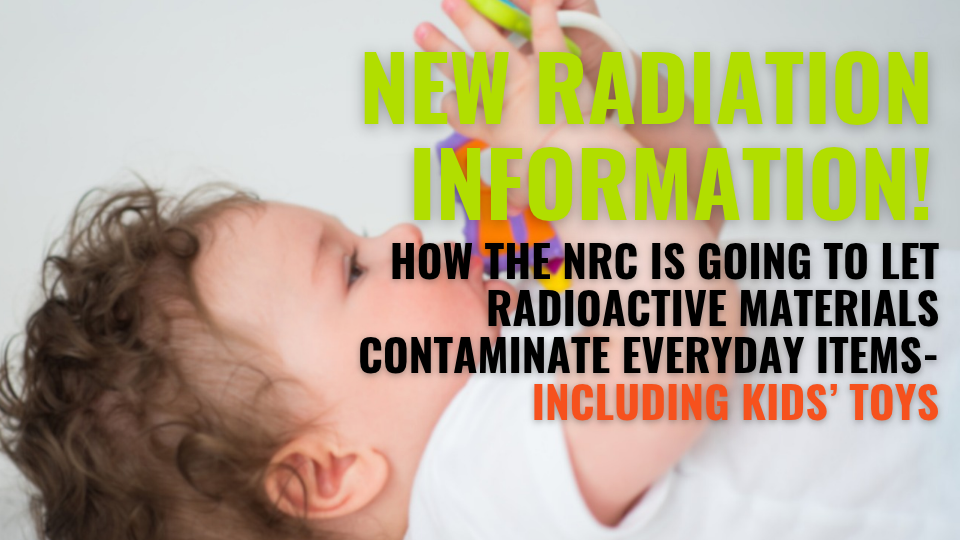
Radioactive waste does not belong in baby toys, frying pans, garden soil, jewelry, roads, cars, building supplies—or any of our everyday household items.
But the Nuclear Regulatory Commission (NRC) is moving to exempt hundreds of radioactive isotopes from the licensing controls that currently apply to radioactive materials and waste.
The rule change, entitled Exemptions from Licensing NRC-2025-1568, lists levels of every radioactive form of every radioactive element—radionuclides—as exempt from licensing. That includes some level of plutonium, cesium, strontium, radioiodines, and nearly 800 more.
In other words: materials currently required to be treated as LICENSED RADIOACTIVE MATERIAL AND WASTE could be moved to an exempt list in 10 CFR 30 and no longer require radioactive-material licensing controls.
And NRC has done no analysis of how much radioactivity could be released over time or how many cancers and other health effects could result.
Why take this risk?
Your comment should make three things clear: Withdraw this rule change. Exempting more radioactive material and waste from regulatory control is not just controversial—it has been widely opposed at many levels for decades. And use the phrase that your comments are significant and adverse. Tell the NRC to withdraw the rule and not exempt more radioactivity from regulatory control. If the NRC chooses to pursue this rule against public opposition and the science, it must first explain how the exemptions will work, how much radioactivity could be released, and what the health and environmental consequences could be. The NRC must also answer the significant questions that remain unaddressed in the draft or final rule.
Send your message of dissent to the NRC at the button at the bottom! Deadline to comment is NOVEMBER 4th by 11:59 PM EST!
Here are some topics you can reword and use in your comments:
1. NO DEMONSTRATED NEED FOR THIS ARBITRARY AND CAPRICIOUS RULE CHANGE
2. Unanalyzed health dangers
3. Unanalyzed environmental dangers
4. Violation and illegal superseding of state laws and regulations and Controversially overruling state, county, city, town resolutions calling for continued regulatory control
5. Allowing contractors to use radioactive materials and wastes without the restrictions of licensing that are currently required.
6. Wastes could get into regular trash, hazardous trash, incinerators that release radioactivity into air and our lungs—along with hazardous chemicals and other carcinogens and stressors.
7. Irreversibility of the releases of radioactive waste and materials into our consumer goods, building supplies, regular trash, air, water and daily use items with which come into intimate routine contact!
Make your comment count!
Your comment should call on the NRC to withdraw this exemption rule change.
The most effective comments will clearly explain why you oppose the rule change, why your concerns are significant, and why this proposal is controversial.
Writing your comment in your own words is best. You can use the talking points below for ideas, but personalize your comment and explain why you believe radioactive materials and waste should remain under regulatory control.
Background:
There are 15 states with laws, and many others being passed, when Congress overturned the exemption policies in 1992 including ME, VT, CT, OH, WI, PA, WV, IA, MN, OR, TX, NM, IL, SD, CO. These states passed laws or regulations requiring continued regulatory control over radioactive wastes and materials even if the federal government or other states exempted them from regulatory control.
NRC claims the change would save regulators $6 million over five years—a little more than $1 million per year. But the cost of managing and dealing with even one cancer could far exceed that trivial savings. The public would instead bear the potential health and economic costs.
We have fought this before.
This approach was previously called Below Regulatory Concern (BRC)—and the public overwhelmingly opposed it.
Congress revoked both of NRC’s policies to deregulate nuclear waste and materials in 1992. NRC withdrew its 1986 and 1990 BRC policies in 1993 after intense public opposition.
Since then, NRC, EPA, DOE, and DOT have tried at least 15 more times to deregulate nuclear waste, materials, emissions, and practices—and the U.S. public has opposed every effort.
Today, 14 states have laws against deregulating nuclear waste, and dozens of counties, towns, and cities have adopted resolutions opposing BRC.
Tell NRC: Radioactive waste belongs under radioactive controls.
NRC must answer some fundamental questions before exposing the public and environment to irreversible radioactive releases:
Where is the demonstrated need for this rule change?
Why hasn’t NRC analyzed the health dangers?
Why hasn’t NRC analyzed the environmental dangers?
Why should $6 million in projected savings over five years justify shifting potentially enormous health and economic costs onto the public?
Why should contractors be allowed to use radioactive materials and wastes without the licensing restrictions currently required?
Once deregulated, these wastes could enter regular trash, hazardous waste, incinerators, consumer goods, building supplies, air, and water. Incineration could release radioactivity into the air and our lungs alongside hazardous chemicals, carcinogens, and other stressors.
And once radioactive materials are dispersed into our products, communities, and environment, we cannot take them back.
There is NO SAFE LEVEL of radioactivity. There is no justification for adding more man-made radioactive waste to our environment and our families just to save regulators a little over $1 million per year.
Tell NRC: Keep radioactive waste under radioactive controls.
|